Davie Construction’s success depends on much more than what happens in the field. Every project requires precise coordination, accurate documentation, timely billing, strong communication, and consistent attention to detail. Our Project Accountant team plays a vital role in bringing all these elements together.
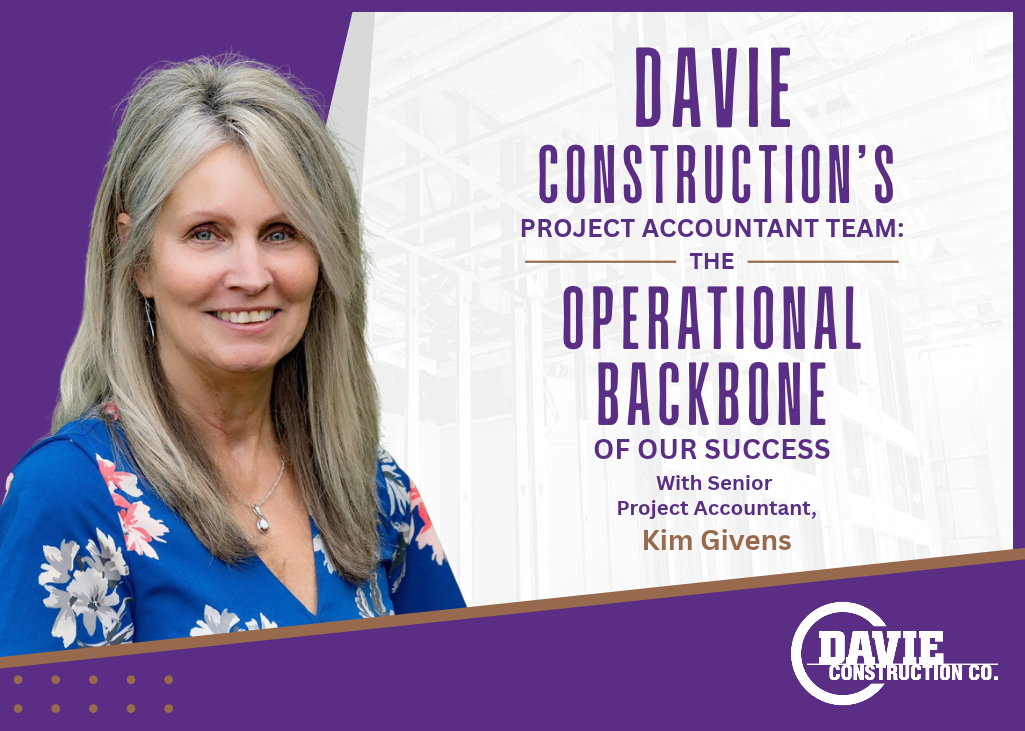
Led by Senior Project Accountant Kim Givens, the team has evolved from project administration into a central operational resource, with direct responsibility for billing, compliance, documentation, and project coordination. The expanded functions reflect the team’s integral role in creating and maintaining a seamless flow of data to our owners and those responsible for completing exceptional projects for them.
A Team Involved from Start to Finish
The Project Accountant team supports every project throughout its entire lifecycle. Work begins during pre-construction, when jobs are established in the system and project responsibilities are assigned. Once a contract is executed, the team helps organize drawings, specifications, and field documentation through ProjectSight, a sophisticated cloud-based construction project and site management software platform.
The team also compares permit plans with original bid documents, verifies that field teams have the most current information, confirms that subcontract agreements are executed, and monitors certificate of insurance compliance. These responsibilities help ensure projects start with the right information and stay well organized as work progresses.
Monthly billing is another essential responsibility. Project Accountants prepare and submit pay applications to owners, a process that can range from a simple submission to 120–140 pages of supporting documentation on complex, government-funded multifamily projects. Accurate, timely billing keeps cash moving through the project and helps prevent delays in subcontractor payments.
The Checks and Balances Behind Every Project
Project Managers and Project Accountants have different responsibilities, but the roles are closely connected. Project Managers focus on budgets, change orders, subcontractor buyout, schedules of values, field coordination, and day-to-day project execution.
The Project Accountant team provides an important system of checks and balances. Team members identify missing documentation, change order discrepancies, compliance gaps, and other issues that could easily be overlooked in the fast pace of active construction. This support lets Project Managers stay focused on field operations while ensuring administrative and financial requirements stay on track.
Kim describes the Project Accountant team as the central hub of Davie’s operational system because the team connects pre-construction, estimating, project management, field operations, and executive leadership. That broad perspective gives the team a unique understanding of how individual decisions affect the entire project.
Accuracy, Organization, and Follow-Through
The team exemplifies the qualities essential to construction operations: attention to detail, organization, adaptability, proactivity, and compliance vigilance. Project Accountants manage multiple projects at different stages, each with its own requirements, personalities, schedules, and documentation. A structured checklist system helps ensure that critical startup and ongoing steps are not missed. At the same time, each team member develops best-practice methods for tracking tasks and following up on open items.
The work also requires persistence. When information is missing or a response is delayed, the team cannot simply wait. Project Accountants actively follow up with project teams and stakeholders to keep documentation, approvals, and billing moving forward.
Using Technology to Improve Collaboration
Technology helps our Project Accountant team manage an ever-expanding project portfolio while maintaining the highest quality. ProjectSight provides a shared platform for drawings, specifications, RFIs, submittals, daily reports, and project communications.
The platform’s role-based access lets each stakeholder see the information relevant to their role. Subcontractors can access documents related to specific scopes of work, while owners can view project communications and submittals without accessing financial details or daily reports. This structure improves transparency while keeping information organized and appropriately controlled.
Kim helps introduce technology that supports efficiency and she encourages the team to identify ways to enhance their work processes for the benefit of our owners. Tools such as Microsoft Copilot can support email searches and task prioritization, while digital systems make it easier to identify open issues, track progress, and communicate updates in real time.